TIME Spotlights Op-Ed By “Conversion Therapy” Survivor Tim Schraeder Rodriguez as Supreme Court Weighs Challenge to the Discredited Practice
The author and survivor behind 'Conversion Therapy Dropout'' calls for national accountability and reminds the nation that faith should never demand self-erasure: “I Mistook Shame for Faith”


FOR IMMEDIATE RELEASE
New York, New York — October 7, 2025 — TIME has published a powerful new op-ed by author and survivor Tim Schraeder Rodriguez, bringing national attention to the human toll of so-called “conversion therapy” as the U.S. Supreme Court considers a pivotal case that could determine whether states can continue to ban the discredited practice.
In his deeply personal essay, titled “I Spent Eight Years in Conversion Therapy Mistaking Shame for Faith,” Rodriguez recounts the years he spent being told his faith and identity could not coexist—and how he ultimately found freedom by rejecting the shame those programs instilled. His story underscores what’s at stake for countless LGBTQ people should the Court roll back protections that have saved lives across the country.
"When I first started conversion therapy at age nineteen, I thought I was pursuing healing for what I was led to believe was broken in me. I didn’t want to erase myself. I wanted peace. I wanted to stop feeling like my faith and my sexuality were at war with one another. I sought it out of my own accord. My parents and pastors didn't force me into therapy, but everything in the culture around me convinced me it was my only option."
The op-ed follows Rodriguez’s presence at the Supreme Court earlier this week, where he joined advocates and fellow survivors rallying as oral arguments began in a case that challenges state bans on conversion therapy for minors. His perspective adds a critical survivor lens to national coverage dominated by legal and political voices, reminding the public that behind the arguments are real people whose lives were permanently altered by these practices.
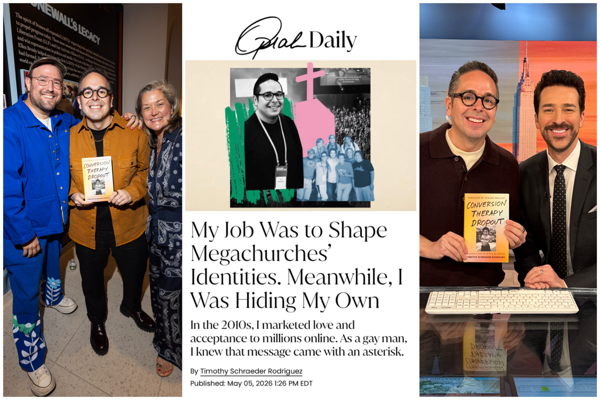
"The irony was that this performance followed me into my career. I worked for some of Evangelical Christianity’s largest megachurches, like Hillsong, Willow Creek, and Elevation Church, where I helped craft messages of belonging for millions. But my presence in these spaces operated by unspoken rules: I was useful in the shadows, but unacceptable in the light. I was selling the idea of love and acceptance while practicing self-exclusion."
Rodriguez’s story represents a growing movement of survivors speaking out to ensure the truth about conversion therapy is not lost amid constitutional debate. His forthcoming book, Conversion Therapy Dropout, expands on his journey of faith, recovery, and advocacy—and invites readers to reconsider what healing truly looks like.
"The danger of conversion therapy isn’t just the trauma it causes. It’s that it disguises shame as healing. It teaches people to doubt their own goodness. It tells them peace is possible only if they become someone else. Real healing isn’t about erasing what’s wounded. It’s about telling the truth about where it hurts. That truth didn’t come easy for me. I had to rebuild a faith that could hold my full humanity. I had to learn that love and shame cannot exist in the same space. I had to believe that God's love was bigger than the box I’d been told to fit it inside."
Read Tim Schraeder Rodriguez's full op-ed here:
In response to being photographed outside the Supreme Court in a shirt saying "Conversion Therapy Dropout" and initially appearing in wire images as a nameless man with that shirt, Rodriguez has made the the shirt "Conversion Therapy Dropout," where a portion of sales will be donated to The Trevor Project.

###
About Tim Schraeder Rodriguez: Tim Schraeder Rodriguez is a writer and advocate whose work explores the intersections of faith, sexuality, and belonging. A survivor of eight years in “conversion therapy,” his essays have appeared in outlets including National Catholic Reporter and Religion News Service. His forthcoming memoir, Conversion Therapy Dropout: A Queer Story of Faith and Belonging, chronicles his journey from coercion to healing — and calls for a faith that liberates rather than confines.